
Homegrown food that’s easy and sustainable? Here’s how
Allotments in the UK
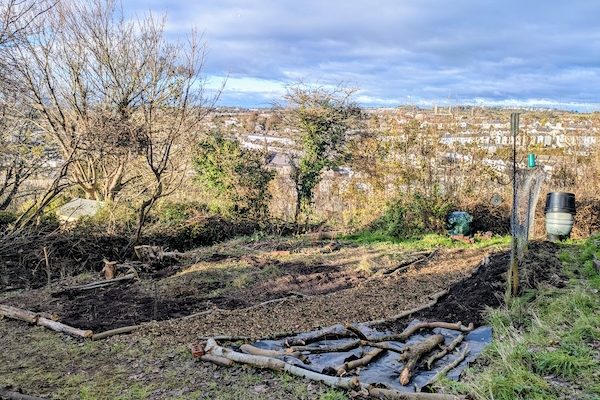
If your mental picture of an allotment is from Instagram, it will include sunshine, neat rows of healthy veg and stylish sheds made from foraged wood. If you’re feeling more realistic, you might add torn sheets of black plastic, old baths and unwanted pallets to your image.
But you’ve probably never pictured an allotment with a food forest.
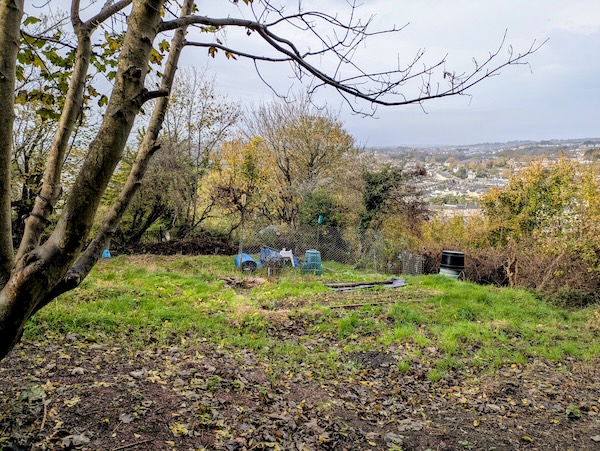
I waited six years for my allotment.
And now I have it, I’m planning something a bit different.
So what is an allotment?
An allotment is a small section of land rented from a landowner (often the local council) in order to grow food and sometimes keep animals such as bees, rabbits and hens. Many districts have private allotments as well as local authority ones and some of these are managed by committees. Rents are usually very low and allotments often come with a water supply.
Food forest allotments are unusual.
A quick history
Common land was once communally owned and divided up (often in strips) for families to grow food. In the late 16th Century, a process known as ‘the enclosures’ saw this land being given to the wealthy.
As compensation, small sections of land (allotments) were allocated to individual families. This compensation didn’t help everybody and some of the very poor starved.
Much later legislation attempted to provide for those without their own land (most people) but relatively little land was set aside for the purposes. Land ownership in the UK remains unfairly skewed in favour of the very wealthy.
Allotment popularity in the UK has gone up and down. The wartime ‘Dig For Victory’ campaign, increased home-building and even the BBC’s ‘The Good Life’ sit-com have all had their impacts.
In the last decade, concerns about pesticides, food security and big food company monopolies have led to more of us wanting to grow our own foods.
Including me.
How big are allotments?
Allotment sizes in the UK vary and often depend on the history of the individual allotment gardens. The most common full allotment size was ten rods (250 square metres) and was deemed big enough for one family but modern allotments are often allocated as half (125 sq m) or quarter (60-70 sq m) plots.
My allotment is a full plot.
Allotment waiting lists are often long but modern allotment organisations are springing up to help fill gaps. Roots Allotments have 20 sites across the UK (Jan 2026) and rent out plots as small as 12 square metres. For a slightly higher rent than some, they offer a service that’s great for beginner growers and includes tools to use, seeds and plants and training events.
More people want allotments than have them.
Food forests vs traditional veg gardens
Successful vegetable gardens usually include these key ingredients:
- Sunlight (south facing is a win)
- Water (from rain or the hosepipe)
- Nutrients (especially nitrogen, phosphorus and potassium)
- Protection (from wind and pests)
Both food forests and traditional veg patches can provide these in different ways.
Sunlight – Planning your planting so that shorter plants won’t be shaded out by taller ones makes sense in both food forests and traditional veg plots. But because the perennial plants in a food forest last longer and grow bigger than most traditional veg, food foresters pay a lot of attention, at the planning stage, to light requirements, ultimate plant size and growing habit.
Meaning they get the maximum output from the available rays.
Water – Traditional vegetable gardens have a lot of bare soil. This is vulnerable to drought and nutrient loss through runoff. Mimicking natural growing patterns, a food forest uses low-growing and ground cover plants to protect the soil and reduce evaporation. Food forest leaf drop and permaculture systems like berms and swales also improve the soil’s ability to hold water.
Meaning you have to water it less.
Nutrients – In a traditional garden system, nutrients are added to the soil via imported ‘treatments’ such as manure, compost and leaf mould. These can be dug in or left on top of the soil. No-dig gardening is becoming increasingly popular because it doesn’t damage soil structure.
A food forest is a no-dig system that, as well as food, includes nutrient-rich plants, that can pull nitrogen into the soil from the atmosphere or use their deep tap roots to bring up deep-soil nutrients into leaves that can be used as ‘chop and drop’ living fertiliser.
Meaning a food forest effectively feeds itself.
Protection – Both food forests and traditional veggie gardens use wind breaks to protect vulnerable plants. In a food forest, these will usually be taller trees. Protection from pests is an interesting one. Most vegetable gardeners now know about how companion planting and a more natural system can help with this but a food forest also combats pest damage by using perennial plants that can withstand more damage and planting a wide variety of plants in mixed beds.
Meaning you need less tunnels and netting.
Why am I planting an allotment food forest?
I’m not here to tell you what to do.
But I can tell you why I’ve opted for a non-traditional food growing system (and hope that you follow along to learn from my beginner mistakes). I’ve put the reasons below in order of importance for me but your priorities might be different.
- I would like to be as self-sufficient in food as possible and I believe a food forest will help me get a higher yield from my plot. I object strongly to our food systems being in the hands of a few profit-eager companies, and to what those companies are doing to our farmers (through unfair practices) and our health (through ultra-processed foods). I’ve shopped supermarket-free since 2023 and want to supplement even more of this by growing my own food.
- I love nature and recognise that growing food in a forest garden system will give back to nature in ways that my traditional garden can’t. More trees and bushes are great for the environment and birds, more flowers are great for insects and bees and, by avoiding monocultures and planting as big a variety of food and support plants as possible, I won’t just be providing more wildlife habitat and food, I’ll be future-proofing my food production against climate change.
- My outdoor education work and train walks research are going to take me away from my allotment during the late spring and early summer months. Months during which a traditional garden requires lots of work. I need a food garden that will feed, water and generally look after itself when I need it too. And still be healthy, beautiful and bountiful when I come back.
- I love trees and believe that being in forests is good for our wellbeing.
Are food forests allowed on allotments?
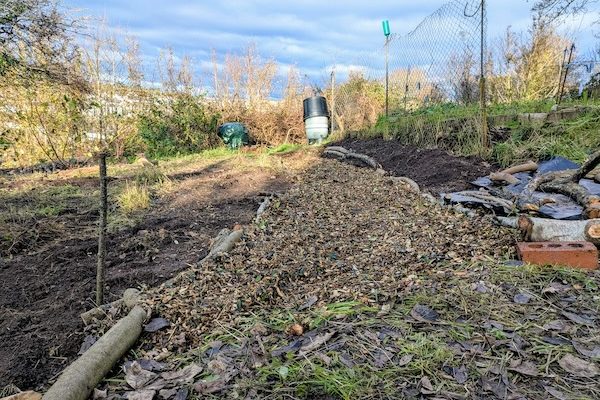
Before you take on an allotment, I recommend you read its rules. These can vary from extensive and restrictive to relatively free. Things that might be limited at your allotment could include:
- The number of trees you’re allowed to plant
- The building of structures (and their removal)
- Whether your dog is allowed at your allotment
- How big an area you’re allowed to leave for wildlife
- Which animals you can and can’t keep
- How tidy you need to keep your plot
- Whether or not you’re allowed bees
- How you can access water
- Who is responsible for your plot boundaries
- What you need to do before you leave your plot
Perhaps the most important thing to do if you’re considering planting a food forest is to consider your fellow allotmenteers. Plots are often packed tightly together, if this is the case, larger plants, especially trees are likely to have an negative impact on the amount of food your neighbours are able to grow.
I only have one set of close allotment neighbours.
Through careful planning, it might be possible to avoid ill-placed shaded areas but you could also consider a planting system that works like a food forest but on a smaller scale. By using shrubs instead of trees but still including different layers as well as nutrient-providing plants, you can access most of the benefits of a larger forest system.
My home garden includes mini food forests in raised beds.
What could possibly go wrong?
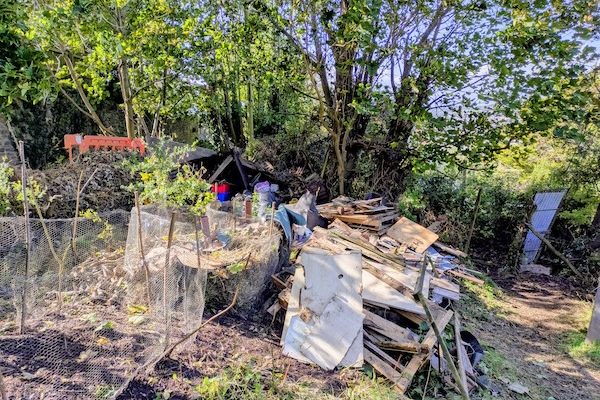
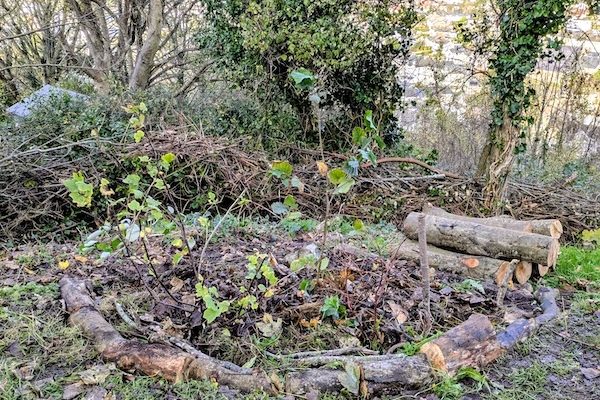
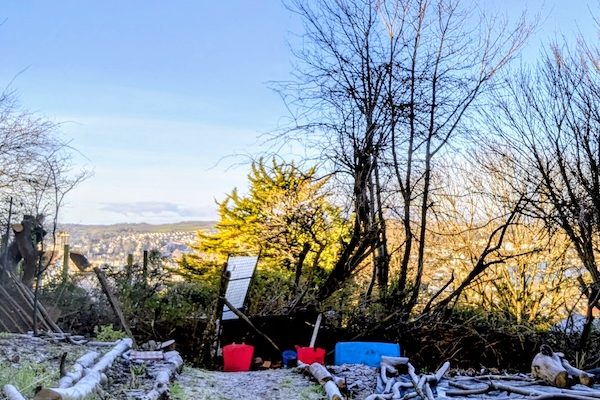
It’s taken me five months to clear rubbish, build a dead hedge boundary and create sensible paths around my allotment. I still don’t have a proper gate but I have started planting trees and shrubs.
Nothing major has gone wrong yet.
But I did have a whole set of garden tools stolen. I’ve taken this as a lesson in expectation. An allotment isn’t the same thing as a private garden and allotment theft is apparently more common than I thought.
My plot is very visible from the public footpath that borders it.
Which in some ways is lovely. I’m getting to know my local community better and I love answering their questions about what I’m up to. I’ve even been brave enough to say, ‘I’m planting a food forest.’ This sense of community is important to me and, as my forest garden grows, I’m keen to share the experience face to face as well as online.
But I obviously don’t want any of my hard work to be undone by disrespectful visitors. I’m forming a plan to deal with this, which mainly involves making the plot look uninteresting to thieves (for example no shed) but hopefully also turning it into a community asset by planting ‘sharing’ food plants that will be accessible from the path, offering ‘spare’ fruit and veg for free, and inviting people in to see what I’ve been doing.
All of this is just in the planning stage.
I’ve got to finish planting my food forest first. If you want to find out how I get on, feel free to follow me on Instagram (@FiDarby). I’ll also be publishing blog updates here on fidarby.co.uk
Related News

If you’re anything like me, you like to pack a few snacks and a hot drink when you’re …
Existing allotment gardeners, please help me solve this I’m new to allotment life Supermarket-free life just got …
How I saved money staying out of supermarkets Why don’t I shop in supermarkets? After reading about …
