
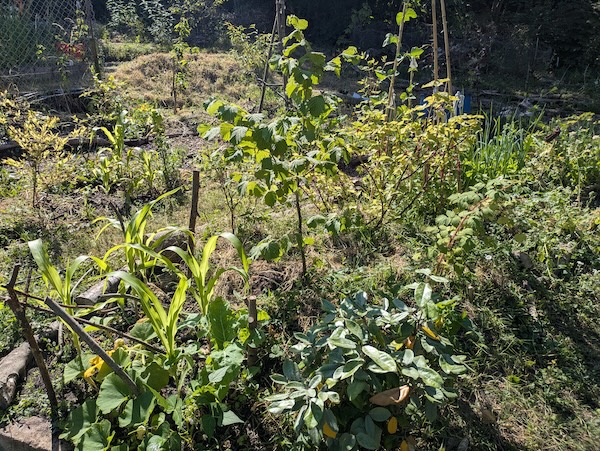
A food forest garden? On a UK allotment? Here’s how.
Six years on the allotment waiting list
There is a massive shortage of allotments in the UK. You have to be patient to get to the top of a waiting list. I was and after six years I did eventually make it.
On August 19th 2025, my allotment dreams came true.
Having experimented with forest gardening in my small, north-facing home garden, I already knew the benefits of this no-dig, nature-based way of growing food. And I needed to supplement my supermarket free food cupboard. But this was a much bigger plot, with more sunshine… And way more brambles!
There was more work to do than I imagined, but even in its first year, the food forest has been far more successful than I could have hoped for. It’s now November 2026 and I’ve only bought vegetables twice since the start of July.
A year of hard work and reward
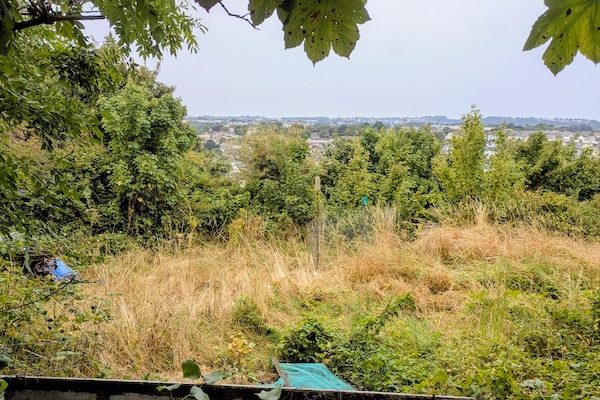
As it turned out, the brambles were the least of my worries. As soon as I started clearing the plot, I realised how much human rubbish had been left by previous occupants and passers-by. It felt as though the land was sinking under the weight of all the glass, carpets, barbed wire, plastic and (weirdly) crisp packets I found.
Here’s the month-by-month story of how I released it.
August 2025
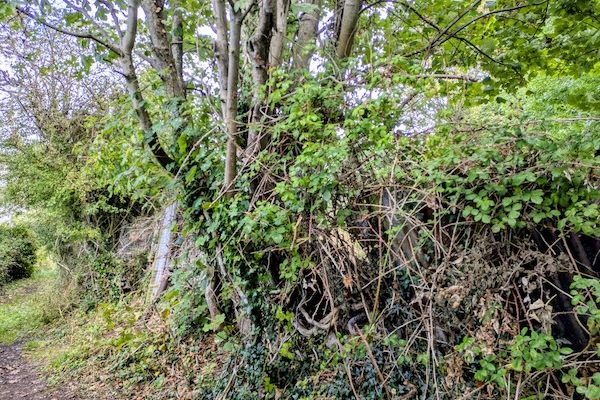
One of the reasons I was so thrilled with my new plot was the number of trees along its borders (and as it turned out, hidden in the brambles). Although you can start a forest garden in the middle of a bare field, there are enormous benefits to having the canopy trees already there.
So my first job was to discover them.
They were mostly sycamore but I also found two ancient hawthorns, numerous small blackthorns, a large and a sapling holm oak and a healthy statuesque ash (with its own seeded sapling). Most of these formed an overgrown hedge and were along the south side of the plot so were going to shade the garden in the summer.
September 2025
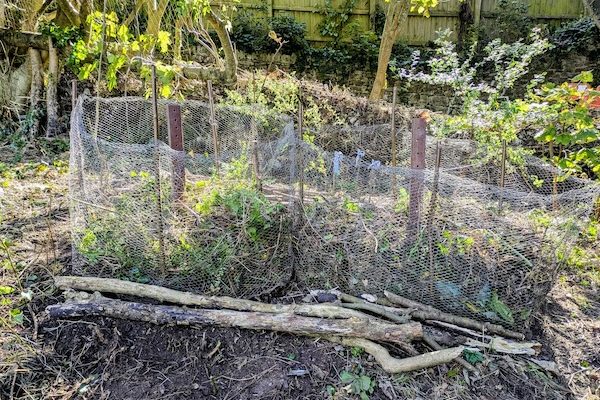
And then the rubbish clearing began. The tall trees weren’t providing much protection from the footpath that ran past the plot so I decided to create an inner hedge from sycamore and blackthorn saplings. I also used all the natural material I cut back (mostly brambles at this stage) to create a thick dead hedge.
As you can imagine, this was a slow, methodical process. As I went the pile of man-made rubbish grew larger and my body grew stronger. Underneath the bramble I found tiny trees, cyclamen corms and signs of bluebells and primroses. I used some of the chicken wire I found and sycamore sticks to create two composting areas (these are still in use and working well).
It was a daily slog but a magical one.
October 2025
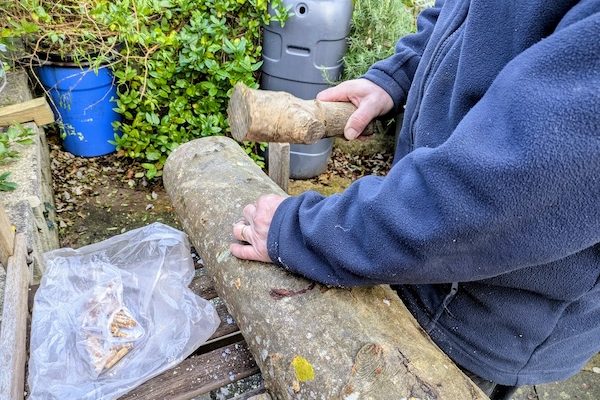
With the rubbish piling high, we managed to persuade the local authority to come and remove it for us. What had taken weeks to dig out took only an hour to disappear and the space left behind looked enormous. The best rubbish collection had to be the 300 or so Fanta cans Mr D pulled out of one ditch.
It was late in the year but I managed to clear away enough grass to plant garlic, sow field beans (broad beans’ stockier cousins) and, with the help of my son, create a wildlife pond from the upturned base of a water butt.
The family stepped in this month with Mr D strimming and my son taking the top off a dead sycamore. We acted as ground crew for this operation and, from hugelkultur areas to log edging, I found a use for every part of the tree.
We even inoculated some of the logs with mushroom mycelium (no results yet).
November 2025
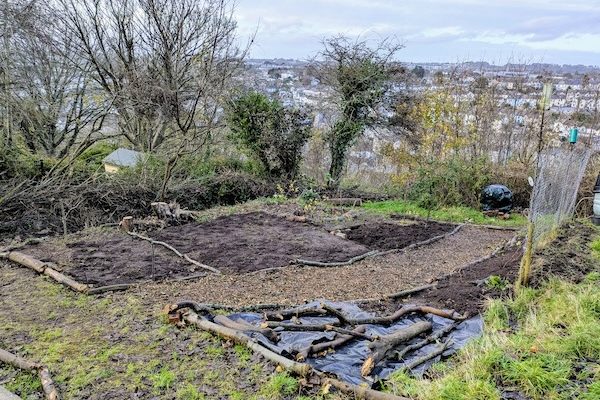
November was a very exciting month because I had finally cleared enough ground to start planting my food forest. The first trees to go in were three cobnut trees I had been looking after in the garden with hope of finding them a bigger space.
Around them I planted honeyberries, blueberries, wineberries, currants and elaeagnus (for nitrogen) in the shrub layer with white nettle, Welsh onions, chives and bugle (edible and medicinal) as ground cover.
Everything went in with a deep mulch of green covered by a blanket of small and then larger sticks. I even added some logs to make sure I encouraged as much mycorrhizal activity as possible (mycorrhiza help plants access soil nutrients).
Between my main food forest beds, I created wheelbarrow-wide paths of woodchip, a gift from my son who delivered a huge pile of it one soggy evening. I was amazed by how much warmth the woodchip produced and drank more than one cup of tea snuggled into it with a plastic bag to keep my bottom dry.
Given the state of the allotment when I got it, it’s hard to believe now that I had been able to start planting in just three months. I did get a shock though, when the first frost appeared. Used to the shelter of my home garden, I had to revise a few plans for future planting. This was definitely going to be food forest with distinct seasons. It was a joy to find fox prints in the frost.
December 2025
December wasn’t quite the month off you might imagine. We had more frosts but on warmer days I was up at the allotment continuing the clearing process. I planted some loganberry and raspberry roots from my sister’s garden to form a fruiting boundary with the public path. The idea was to create a help-yourself-area for children as they walked to school. I’m hoping this winter to add a couple of apple trees to this space.
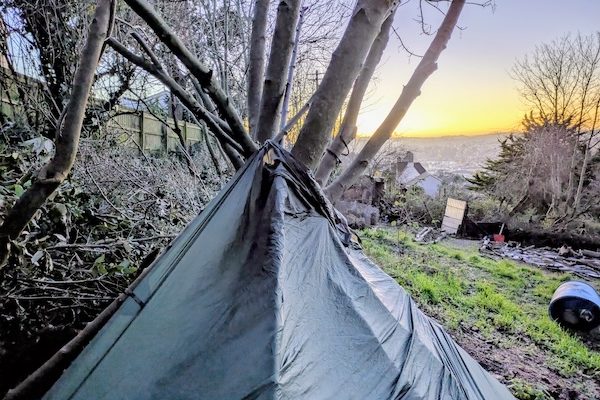
It was around this time I decided to spend a night at the allotment and created a small bivvy space under one of the sycamore trees. It wasn’t my most successful sleepout ever (I went home at four in the morning) but it did feel good to have been part of the place during the night hours.
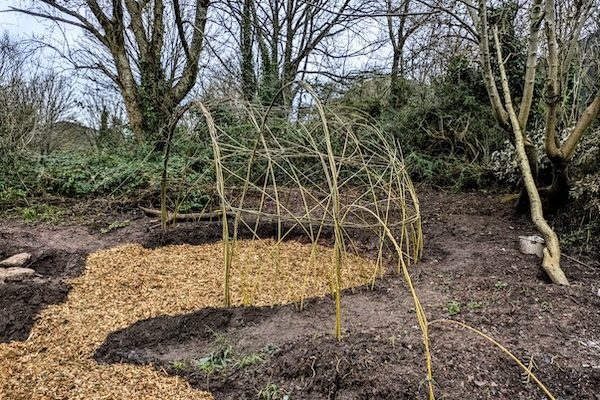
I started to realise how much stronger my body had become with all the digging and clearing. I started to dig out paths on the top terrace, using the turfs I took out to create water-retaining berms for a new forest garden section. One big (but really enjoyable) project was to dig out a circular flat area for a willow shelter. Break-ins on other plots had put me off the idea of a shed but I wanted somewhere we could see as ‘home’ while we were working. The soil I took out of the shelter area has created a very successful planting zone.
During December I started to experiment with creating different natural boundaries using the materials I had available. Permaculture encourages a no-input or limited-input approach and I was keen to make use of everything I had. My favourite at the time was my sycamore and bramble low weave barrier, designed to give the dog an idea of where he was allowed to go but the bramble has since proved to be painful when I have needed to weed so I’m not sure I’ll repeat the experiment.
I knew there was a badger sett nearby but hadn’t seen any signs of them on the plot until, one December morning I discovered a neat but substantial hole tunneling deep under one of my main beds. I blocked it off and hoped for the best. We still get badger visitors but they have so far caused minimal damage and I believe are eating the slugs as well as a few potatoes.
Although I didn’t register it at the time, December 2025 was the month when the food forest first started feeding us; I was thrilled to discover swathes of wild garlic growing just outside my gate. We’ve been eating different types of onion ever since.
January 2026
By now the field beans had reached a foot tall, impressive work with the hard frosts January brought (it also brought plenty of rain). I had planted the beans in my newly cleared (of grass) annual bed on the top tier but also amongst my trees and shrubs in the food forest (to provide nitrogen). I was very pleased to see the food forest beans in their less clear ground were doing as well as the beans up top (they eventually harvested well too).
The garlic and elephant garlic were also looking promising and I was thrilled at the thought of finally harvesting (and plaiting) my first successful crop of brown onions. The allotment was already giving us a bountiful supply of wild garlic (ramsons and three-cornered-leek) and it was at this point I realised that it might be possible to grow fresh alliums and onions all year round (this has since been achieved with increased chive, perennial leek and spring onion plantings).
The main event of January however was the creation of my living willow shelter. I bought a kit online from Musgrove Willows in Somerset and spent a very happy three days planting and weaving. I can thoroughly recommend the experience.
The shelter initially grew well but struggled through the later heatwave and I lost some stems. This autumn I have mitigated against a repeat of that problem by improving and increasing the soil around the base of the shelter and planting herbs to keep the moisture in. I hope this works, the willow shelter and its nearby fire pit have become the heart of the allotment. A place we all love to be.
February 2026
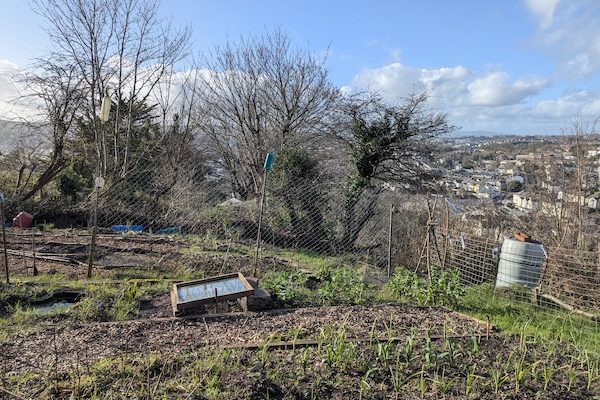
By February the sun was starting to return to the plot and I could already see signs of spring. A bank of primroses started to appear and it was obvious that a host of bluebells were going to follow. I decided that the sloping bed just inside the gate would be a place of year-round flowers and was keen to see tulip Uncle Tom follow on in the weeks to come.
I think this was the first month I felt like the plot really looked like an allotment. Passers-by and neighbours started to comment and I realised that instead of working on enclosing my space, I was enjoying sharing it with the community of people who came to stand on the boundary bank and admire my work.
I created a makeshift cold frame and attempted (with minimal success) to grow rocket and mustard underneath it. Meanwhile, at home, in the bakery warming cupboard, I was nursing the saved seed tomato seedlings I was hoping to dot around the food forest later in the year (I did and we had an amazing harvest from July right into November). I’ve even left a few tomato plants in the ground in the forest garden section to see what happens.
March 2026
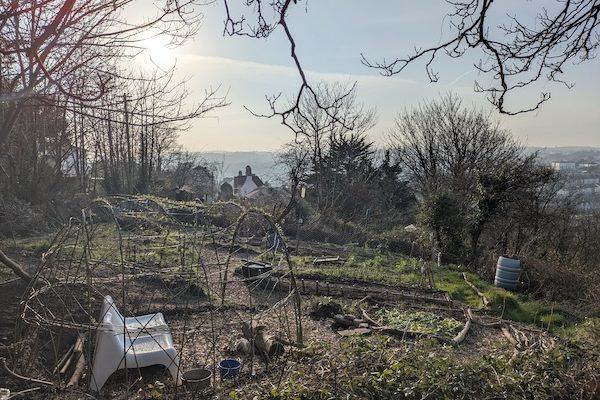
March was a month of spring delights with my first daffodil and green sprouts appearing on the living willow shelter. The allotment looked the tidiest I have ever seen it. I’ve since realised (and accepted) that food forest life means it’s never going to look that tidy again.
Foodwise, the beans and garlic were still doing well and I bought some interesting food forest plants including comfrey roots for mulching goodness, yacon (a tuber) to see how well it did (watch this space) and mashua (another tuber) because I thought its leaves looked pretty in the pictures.
I haven’t harvested any yacon yet (Nov 2026) but I will be doing so soon now we’ve had our first frost. I have tried the mashua and it wasn’t my favourite thing to eat. As it’s a perennial and here to stay, I’ve put it alongside Jerusalem artichokes (which I’ve planted in another area) in the ’emergency soup’ category in my head.
With UK food security becoming a talking point, I was starting to explore the idea of ‘stealth’ vegetables. Allotment thefts do happen, especially when people are hungry and my plot is particularly exposed. One of my longer-term plans is to allow the food forest to overspill the allotment boundaries to create a help-yourself community vibe up and down the path.
April 2026
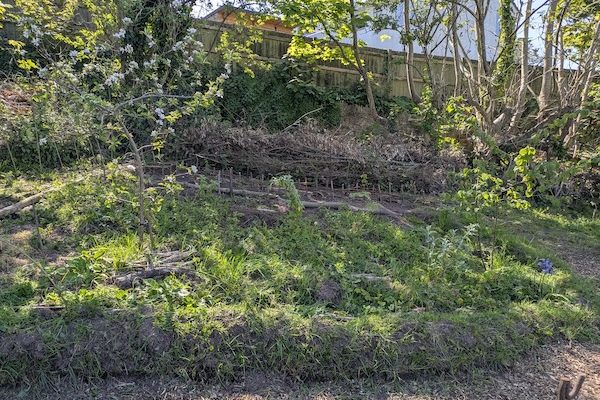
In April the pace moved from the steady plod of clearing and bed creation to a busy planting and sowing schedule. I was striving for diversity so annuals and perennials were getting equal attention; there are over 100 different food plants in the food forest now (Nov 2026).
Highlights included my Asturian tree cabbage, a perennial cabbage that has proved to be tough, both against snails and stir-frying, copious radishes interspaced with parsnips (a success I shall be repeating), skirret, a perennial root that I haven’t yet harvested and orach (aka mountain spinach), which has to have been the success story of the summer 2026 heatwave.
I also turned my attention to an area we have nicknamed ‘Buddleia Close’. It was clear when I got the plot that this space was already in the process of turning itself into a forest (this is called ‘succession’ and is what nature does best) and I didn’t want to interfere too much.
I had already planted fruit bushes (gooseberries and currants) in the swale (ditch) behind my water retention berm (mound). And for trees I had added from the garden an apple and one of the precious cobnut trees I had been nursing while I waited for a forever home for them.
But I was determined at this stage, not to remove anything from Buddleia Close. I wanted to encourage the natural forest that was growing so I started what was to become a regular chop and drop cycle, of which the buddleia formed the main part. Dropping thicker and woody elements into a forest garden bed encourages natural soil health and is proving to be really successful for me, despite my urges to pull some plants up by the roots.
I have made an exception to the no-pull rule for bindweed and Mr D has taken on the job of finding and disposing of it.
May 2026
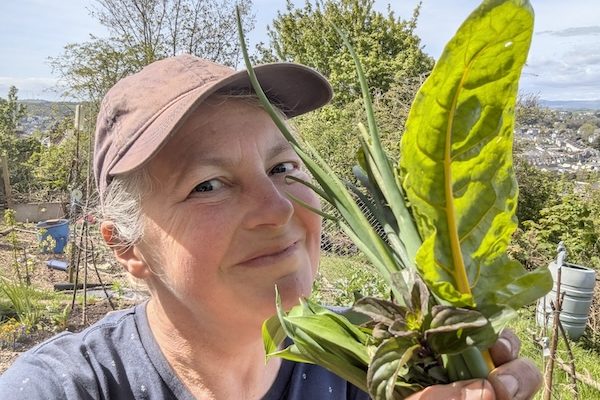
May was the month of magic and super busy on the allotment as well as in my freelance life. Everything was growing at a pace and the food forest sections were really starting to pump. It was hard to see through the brightness of all the green.
I had my first proper harvest of radish, perennial leeks and chard. That was a very happy day.
In the forest garden sections the trees and shrubs looked super healthy (except maybe for the blueberries). I was thrilled to see my red currant bush loaded with blushing fruit (and less thrilled later to see the birds had eaten them).
The field beans dotted around the foot forest looked healthier than the rust-laden ones in my annual bed. I had planted these too close together in the hope of keeping them upright in the wind but by the end of the month, I was harvesting plenty of beans from both. I had healthy-looking parsnips and my list of alliums (onions) was getting pretty long; the leeks, onions, garlic, elephant garlic and chives were all romping away (I have since added Chinese chives to the list).
Not all was success though. The pigeons insisted on eating the new leaves of my kale, turnips and kohlrabi; interestingly they stopped munching later in the year and the plants that had survived ended up doing rather well by the autumn.
The food forest was starting to look pretty with chive and comfrey flowers showing a lovely purple. I celebrated by planting Greek Gigantes Beans in the ground far too early and had to buy another bag of seeds later in the season. This second bag was a resounding success and I now have seed saved for a late sowing next year.
June 2026
June has always been a whirlwind month for me but with my new food forest, this one was bonkers. The allotment was bursting forth and buzzing with insect life. I was very happy to see the bees enjoy my flowers. A couple of flouncy June edibles in the forest garden included floofy purple bread seed poppies (so glorious I spread their seed around instead of saving it for bread) and love-lies-bleeding or amaranth.
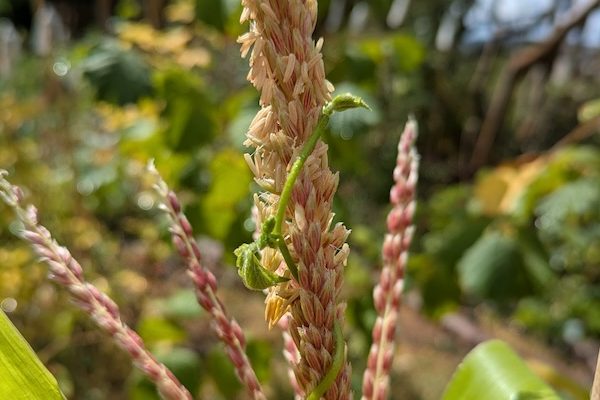
This was an ornamental form of amaranth from seed given to me by my mum but I was able later in the year to collect and winnow (my first time) a small jar of seed. I didn’t realise until too late that the young leaves are a good spinach replacement but I’ve been using the seed in a similar way to quinoa and, as well as being a good protein addition, it tastes lovely and nutty.
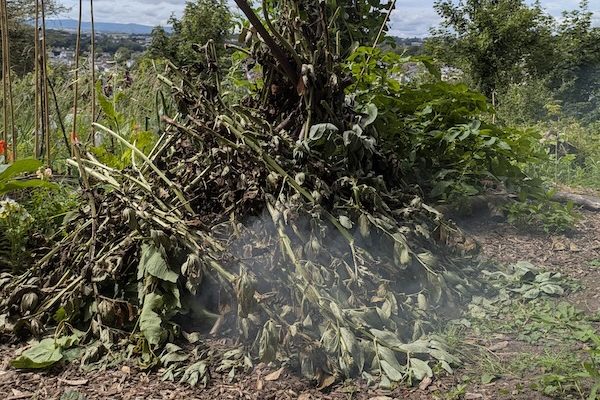
The harvest quantities grew and I was especially excited to gather in my best garlic crop ever. The elephant garlic did well too and I had one particularly lovely afternoon attempting to smoke a couple of bulbs over my allotment fire pit (with field bean stems as a cover). This nearly worked, next year I’ll split the bulbs into cloves and place them more directly over the smoke.
I was so impressed with my elephant garlic that I left some in the ground for 2027 (it’s already showing in November 2026) and planted a few cloves down in my home garden. I’m excited to see how these do and am tempted to move away from annual garlic altogether. Watch this space!
July 2026
July 2026 was in the middle of the hottest UK summer on record and we’ve been told to expect more of the same in 2027. It was a real eye opener for me and confirmation of how important it is, not only to create resilience by growing food but to do it in ways that can survive climate change.
We were at the start of a drought and, until the hosepipe ban in August, I was up at the allotment watering every day. The food forest was already proving to be more resilient than my annual beds but because all my trees were newly planted, I couldn’t risk them drying out and had to water them too.
But it wasn’t all hard work and sweat. I was amazed, after just 11 months, to be harvesting as much food as I was. I only bought vegetables once between the start of July and the end of October. The tomatoes were amazing but there were also peas (I planted British grown Carlin peas from Hodmedods), onions (actual big ones), courgettes (not enough), beans, potatoes, carrots (disappointingly small) and herbs.
My best summer crop was the orach or mountain spinach, it thrived through the heatwave, grew taller than me and kept us in curries and shakshuka for weeks. Even better than that, it provided copious amounts of seed, which I have saved, shared and shaken around the plot. I’m going to need some more spinach recipes for 2027.
August 2026
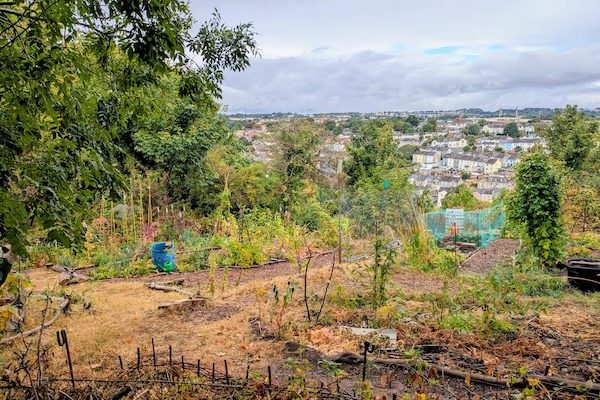
And suddenly I was there. A whole year on my allotment plot. A whole year of creating my food forest garden. I had emerged fitter, with a healthier diet and having learned loads. I had so many plans for the year ahead.
I imagine that won’t change.
We’re now in November 2027 and I’m clearing the final top section of the plot to create a water capture and storage system to mitigate the impact of next summer’s expected heat. I have absolutely no doubts that growing food in a nature-based forest system is the way forward.
On the plot I also have, and very much enjoy an annual veg bed but it’s less resilient to weather and pests than the forest garden sections. I’m already considering adding trees on its north side, including more perennials (e.g. elephant garlic) and mixing up the plants instead of planting in rows.
One thing I’ve definitely learned is that UK forests don’t grow quickly. My trees aren’t going to be producing fruit and nuts for a while and this is a rented plot.
But it was a recent visit to Cappadocia in Turkey that helped me realise I was planting a legacy. Hidden in dusty rock valleys we found permaculture gardens full of food and medicinal trees and shrubs. They had been there a long time.
I’m approaching 60 now and won’t be here forever.
But my trees will outlast me and one day feed someone else who needs to be fed.
Related News

Find out how to enjoy a healthy life without supermarkets Big supermarkets ensure big profits at the cost …
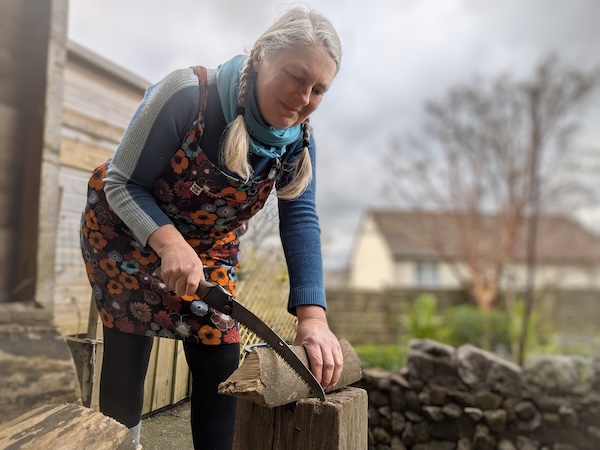
Bushcraft? Pruning? Firewood? This saw makes it all easy You’re looking for a folding saw that makes …
How I saved money staying out of supermarkets Why don’t I shop in supermarkets? After reading about …
